Thursday, February 13, 2014

Culture? Whaaat?

This week's blog post is going to be just a bit more straightforward and serious than usual; but it is a topic which must be discussed. Usually these posts are written revolving around the themes of a piece of American Literature. While the last few have been from the post- revolutionary and romantic eras, this short story, "Everyday Use" by Alice Walker is more modern; being published in the 1940's. It deals with the conflicts which we face when it comes to the idea of our culture and our roots.

Everyone has something which they identify with; some sort of cultural aspect which they call their own. Despite popular belief, parents do not always share the same cultural roots as their children; this is increasingly the case with the millennial generation.

But you can't blame us; even if we grew up in the same town that our parents did, went to the same high school, are familiar with the same families, we are still not in the same world as the generation before us.Whether that world is one of progress or poison, well... that's another post.


Should we live out the culture of our parents and their parents before them by using it as our own, wearing it out? Or should we frame it and sit looking at it from a distance, recognizing it but never touching it?

I strongly identify with the themes brought up by this work; growing up in the modern day and age is more complicated when you get past just scratching at the surface. For me, it has never really been an ethnicity thing; as a European mutt, there is not much colorful ethnic tradition in which to partake. It has always been an issue of ideals, interests and priorities. For example, growing up knowing the very Southern way of life which was taught to me by my mother deeply juxtaposes that of the somewhat harsh cosmopolitan world which I am thrust into daily. 

I cannot tell you how many times I had been denied permission to go to so and so’s birthday party as a child because, “Christina, it’s on a Sunday. Sunday is the day of rest.” But don't get me wrong, there are aspects of my parent's culture that I love; I love how I sit down and have dinner with my mother, my father, my sister, and my brother and eat dinner and talk and laugh, while a good quarter to a half of my friends have had to go through and experience the divorce of their parents.

There are things which we pick up from our folks that we don't even notice; like my mother's loud and slow Alabama drawl that slips out when she's talking on the phone to her mother, the same with my father and his upstate- New York speed speak with his mother. Like the fact that has been pointed out to me that I cannot survive without a cup of coffee in the morning (a trait of my mother), or the fact that I speak fluent sarcasm (a trait of my father). But then there are the things that are completely and totally our own, mine being more of a right minded mentality: I paint, draw, write, and all that while my mother is a nursing instructor, my dad runs his own small business and my big brother is studying to be an engineer. 

But that's just how it goes; some things just have to be your own, while others you take from here and there. Some things can't just be given, they have to be adopted. What I do for fun is my own, and who I hang out with is my own, my personality is my own. My political views, my idealogical beliefs, and even my religion, though they are major similarities  and samenesses to that of the people who raised me, I came to on my own; I had to! How can you believe something wholeheartedly if you didn't come to the conclusion yourself?

I guess the point that I'm trying to make is this; although your roots are different than that of your family, you have to find a way of your own to connect back to that culture and to truly make it your own. I carry my head high with a cup of coffee in my hand, The Beatles streaming in through my headphones (can't get enough of the classic rock my dad taught me to love when I was still just a mini- Christina), and the tiniest bit of both of my parent's accents that slip out from time to time, while still being the paint covered- indie rock loving girl that I am.

The way to truly appreciate aspects of your parent's culture is not to force it, or to put it on display,  but rather to intertwine it into your own.


Wednesday, January 29, 2014

Poe Had it Right...

Alright guys. It's Poe time. I always have loved the works of Edgar Allen Poe (I'm not that morbid though, I promise) as they are in a sense the precursors to many a great literary works to come. Think about it. Poe, although retaining a definite style, worked with many different genres; mystery, horror, romance, although I don't really think he worked with comedy much. Someone should've just given poor Edgar a hug.

But I digress... there are many things that Poe did right when it came to writing short stories, specifically horror stories. I think that hollywood could take a few hints from, hmmm, let's say, The Fall of the House of Usher. So let's take these factors that Poe used and make ourselves a horror movie. Brace yourself.

Okay. the first thing that we need is that creepy setting; one that tells the viewer/reader from the beginning that something is off. In the Fall of the House of Usher, Poe does this by setting the dreary atmosphere of the mansion, along with the strange contradictory detail that the condition of the house is good, although each individual brick shows the effects of decay. That sounds pretty undead, don't you think?


Next: the classic psychopath. That one character whose sanity is only so-so from the beginning; this opens up a plethora of plot twist possibilities. Are they the person to blame? Do they simply see what other people don't? Will all of the other characters lose their sanity? You don't know what's up with them! You know why? Because they're crazy! Boom. Genius.  In the case of the Fall of the House of Usher, this character happens to be Lord Usher himself; he seems to have known that his sister was not dead through his unsettling nervousness a long time before the narrator is even slightly suspicious. This, along with the setting of the house of Usher gives us a nice taste of dramatic irony.

And, with this lovely plot setup that we have, there is only one thing more that we need to get it all going; a reason for the main character to stay in the suspicious place which could cause harm to come upon them. Something that keeps them from just saying "hell no" and hauling ass out of that abandoned house. In the case of the Fall of the House of Usher, the narrator is concerned for Usher's health, and upon his request decides to not abandon his childhood friend in his time of need.

So, we have our creepy setting, our crazy person, and the thing that forces us to stay with our crazy person in the creepy setting. So when the time comes, that moment of blinding, intense terror has to be perfect. Our narrator without even thinking runs for his life out of the House of Usher, only looking back later to see it crumble to it's ruin.


Now, the ending is important. After the House of Usher is gone, the reader pictures the blood red moon, the deep, dark night... was it all a dream? Is the narrator crazy? A mysterious ending is key to a good scary movie. I find that the more I have to think about the movie/ story ending, the more it puzzles me, and the more it entertains me. So get obscure, Hollywood!

What's that? If I could change anything about the typical scary movie, what would it be? Well for starters, PLEASE, for once could y'all please kill off the brunette first? I'm tired of my sister blondes always dying first because of that one bad decision to separate from the group. On a more serious note, I would fix the amount of scary to amount of gore ratio. Just look at Poe; not a single instance of bloodshed is described in the Fall of the House of Usher, and yet, it's still a chilling and thrilling story. So get more creative, and less knife happy.

Thus concludes our adventure with Poe and his incredible gift with the genre of horror.

Monday, January 27, 2014

All Things Haunted

There are two types of people in the world; the people who deny the existence of dark forces in our world, and those who are either secretly or openly fascinated by the thought of said evil; maybe even obsessed with it. As American citizens, the idea is thrust upon us time and time again by scary TV shows, horror movies, supernatural documentaries, books upon books of encounters of the mysterious and unknown, and even the feeling you get when you walk past a neon "PSYCHIC" sign in the window of a less than well maintained building. I think it's safe to say that the majority of the American population can be described as the latter of the two options.


But why? Why especially Americans? What does this say about our culture?

Well there is the easily explained theory that us McDonalds lovin' Americans love to poke our noses in places where we really shouldn't be, but hey. This would be a really short blog post.

To see where this infatuation with dark forces, occults, hauntings, and all of the rest of that good stuff comes from, let's take a look at our roots. Think back to American colonization; one of the first significant (and quite dark) events in American history was the Salem Witch trials which were the result of the crazed paranoia of several quite religious protestants. And bingo. Religion. America has been a country full of religious influence since the beginning; but what people fail to recognize about religion is that with the presence of a god figure, representing all that is good and just and holy, we also entertain the idea of the devil, who stands for exactly the opposite.

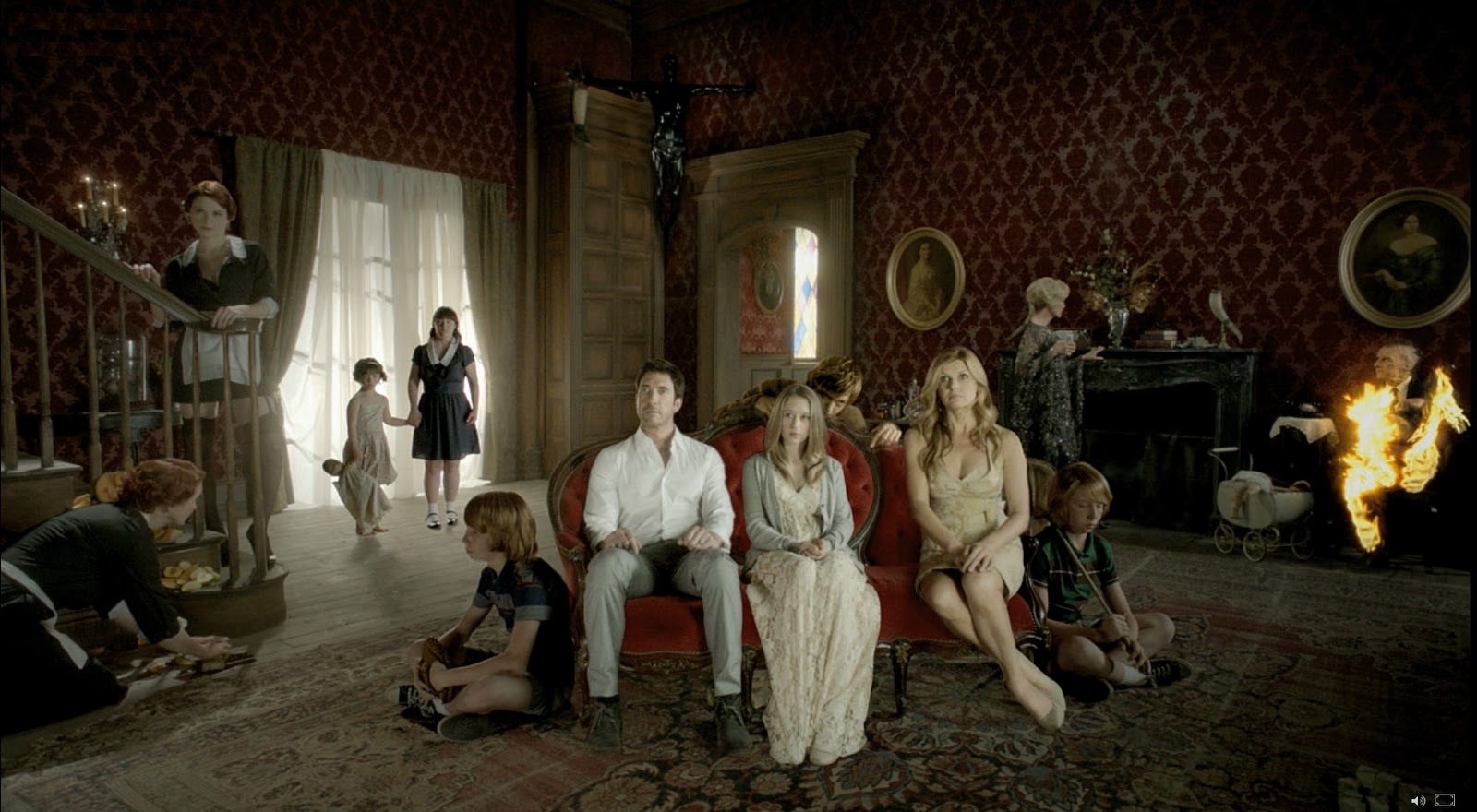
And thus, the creepy, the weird, and the paranormal wriggle their way into past and present pop culture. There are shows like American Horror Story which nod towards the continuing tradition of scary story telling through the images that plague our television screens every October. There are the chilling bed and breakfasts spread across the southern states which tourists flock to in hope of seeing a ghost who was once a soldier in the civil war, there are the numerous books on the shelves of American libraries on topics such as witchcraft and occults for the brave and curious.


So don't be ashamed to express that interest that you have always had in whatever mystical occult that you read about in the third grade but were always kind of scared would pop up if you googled it. We are the offspring of a culture that is ever so curious and obsessive.

Tuesday, January 14, 2014

Ichabod Crane- The Hipster of all Anti-Heroes

The antihero; it is what it sounds like. Unlike the classic hero with rippling muscles and cheekbones that you could cut yourself on, the antihero is that one person who is just so unfit; so unexpected to be the one saving the day, or getting the girl, or winning that oh so coveted national championship in whatever it may be. The truth is, our precious antihero is not a new idea whatsoever.

In fact, it can be spotted in the earliest of classic American literature; in particular, the character of Ichabod Crane in Washington Irving's The Legend of Sleepy Hollow. As I recently read this work, I , quite surprisingly, found myself comparing the character of Ichabod Crane, introduced to the world in 1820, to the character of Carson Phillips from the movie Struck by Lightning, which just came out in 2013. With closer examination, I found several very antihero-ish characteristics that the two share.

1. Both share the combination of having one or several very defining and unique skills which they are known for with a small town environment; this is an ingenious trick that always sets the character up as if we already know them. Ichabod is the Schoolmaster as well as the leader of the choir. Ah, an intellectual and a musician! Despite his other quirks, we already like him a bit. Carson Phillips, a brilliant but stubborn and defiant teenager is known for being the writer of the school newspaper as well as the president of the writer's club. However, the two are different in that Ichabod is painted in a light that makes him look quite popular; but for Carson, as well as all the other high school social underdogs, the case is not the same.


2. Ichabod and Carson don't exactly have the purest of hearts when it comes to getting what they want; both are willing to do what they must to achieve their own happiness. Ichabod, who is "in love" with the beautiful and much more importantly extremely rich Katrina Van Tussel is ready to compete with the most macho of macho men, Brom Bones, in order to gain the extravagant riches which come with her hand in marriage. Carson, a student who will go to Northwestern and nowhere else, blackmails specimens at the top of the food chain into writing for a school literary magazine, the completion of which is sure to get him noticed.


3. Despite some fishy characteristics, we feel bad when our anti heroes leave. What? It's not our fault that they're the protagonists! We wonder what became of Ichabod Crane when he mysteriously disappeared after being haunted by the notorious Headless Horseman. We weep with Carson Phillips' mother at his funeral when he is inevitably (and literally) struck down in his prime.

But the question that I still ask is why? Why do we love our antiheroes so much? They're not always the brightest, or the most attractive, which is what we're usually drawn to; so what is it? The answer I always seem to find is that they remind us of ourselves. We recognize and identify with the brokenness we see in them. We bite our nails and wring our hands when they're in trouble. And if and when they emerge triumphant, we rejoice.

On than note, I leave you with one more movie clip. I hope you enjoyed this!